
To mark International Beer Day (August 7th), we caught up with John Hatch – renown heritage brewer, historian and Heritage Centre Manager at Sambrook’s Brewery.
How and when did you first get into Brewing, and what attracted you to it as a career?
As a student of the 1980s, I received a grant – most of which I consumed in the pubs around my university! When my money ran out, I started home-brewing and became quite proficient. I made so much beer that I used to give it away at parties in my student flat. At one party a fine fellow called Richard exclaimed “This is great, you should do it for a living!”. It was a light-bulb moment and I was then utterly determined to become a Brewer.
You’ve seen the industry change considerably over the years, what would you say has changed the most and what has stayed the same?
When I started brewing in 1987 there were only six main brands of beer across the country (the likes of Bass, Whitbread, Allied, Scottish & Newcastle, Courage & Watney Mann) and some regional/family brewers. The biggest change in that time is the explosion of micro-breweries creating a far wider variety of beers. What has remained unchanged is the constant battle of brewers trying to make a meagre profit against the onslaught of increasing duty, energy and water costs.
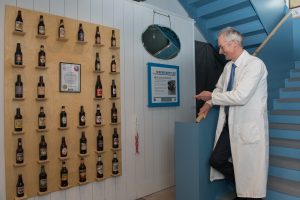
John Hatch at the Ram Brewery heritage display
Wandsworth has a long association with brewing. Why has the borough been so important to Britain’s beer making story?
Sambrook’s currently occupies the longest continuously brewing location in the UK! Brewing on the site goes back to at least 1533 when Henry VIII was King of England. Brewing was very important around London in Tudor times as the water from rivers and wells was often dangerous, so everyone needed wholesome beer to drink instead. The brewing process and the ingredients meant that no human pathogen (food poisoning) could live in beer, making it safe to drink.
When did Sambrook’s launch and who is behind it?
Duncan Sambrook founded Sambrook’s Brewery in 2008 and set the brewery up in Battersea Rise. The business relocated to Ram Quarter in 2020. 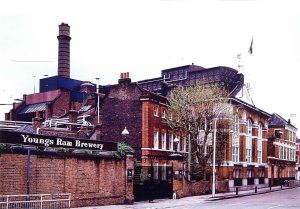
The historic Young’s Ram Brewery on Wandsworth High Street before the redevelopment of the Ram Quarter site.
How unique is Sambrook’s to other breweries and does it have a signature beer?
Sambrook’s is also the oldest independent brewery in London. This is not because we are especially old but because many of the other micro-breweries in the Capital have sold out to larger brewing companies. Our signature beer has to be Wandle Ale, the 3.8% session bitter which has been brewed since 2008.
What should people look, smell and taste for when trying a beer – is there a ‘right’ way to taste it?
I always look at a beer to assess the clarity, then I swirl the glass and smell the aroma. Finally, I sip the beer and swallow. Unlike wine tasting, beer MUST be swallowed in order to appreciate the bitter compounds. My first mouthful is also swirled around my mouth as this liberates the flavours.
For someone that knows little about beer what are the main ingredients and what does each bring to the finished drink?
Water, malt, hops and yeast. Water is essential for the final product; it has to have the correct mineral components depending on the style of beer being brewed. Malt is short for malted barley (as well as other grains such as wheat) and malting means partial germination. The geminated grains are then roasted to dry them out and to create additional colours and flavours. Hops are a flower which provide anti-bacterial properties as well and imparting aroma and a bitter flavour. Finally, yeast converts sugars from the malt into alcohol.
For someone thinking of starting a brewery or crating their own beer brand, where should they begin?
Learn the basics of brewing and then look for a gap in the market. Anyone can brew beer but finding a market for your brand is becoming increasingly difficult as UK beer sales are depleting and competition between the remaining breweries increases.
What are some of the biggest costs/practical challenges new businesses tend to underestimate?
Brewing uses huge amounts of energy, the cost of which is spiralling. Climate change is also affecting the farmers, so raw materials are more expensive. Transport cost of the finished product is also high as beer is heavy and bulky.
What is the most common mistake you see new brewers/beer brands make?
My personal view is that too many micro-breweries are jumping on the bandwagon and creating clones of American style craft beers. This in my view makes many beers taste the same. I think that brewers should strive to make original flavours and give the public more variety.
What tips would you give to an entrepreneur who loves beer and wondering whether they could turn their interest into a business?
For various reasons, pubs in the UK have been closing at an average rate of 15 per week throughout 2026. This is reducing the volume of beer being brewed in the country. The beer going to supermarkets (in cans and bottles) has a very much lower profit margin that casks and kegs going to pubs. This is why breweries are closing down- because the market is flooded. I would not advise anyone to start a brewery in the current climate. Instead, I would encourage everyone to support their local brewery as, once they have closed, it will be too late.
Tell us something people might not know about Sambrook’s?
King Charles poured himself a pint of Wandle Ale whilst visiting a pub in Battersea and said it was very good!
Finish this sentence: I like being based in Wandsworth because…
Wandsworth is the home of the Ram Brewery, the UK’s longest continuously brewing site in the UK!
To discover more of Wandsworth’s rich brewing heritage, book onto one of Sambrook’s upcoming Heritage Centre tours and tasting experiences led by John Hatch at the historic Ram Brewery site. Click here
Where can people find and follow you?